Wearing a helmet can reduce the chance of a fatal head injury in:
(A)
Low-speed crashes only.
(B)
High-speed crashes only.
(C)
Any crash, regardless of speed.
Check Answer
Show Answer
Question: 33
When riding where sand and gravel have collected on paved roads, you should:
(A)
Avoid sudden changes in speed or direction.
(B)
Use only the rear brake to slow down.
(C)
Pull in the clutch.
Check Answer
Show Answer
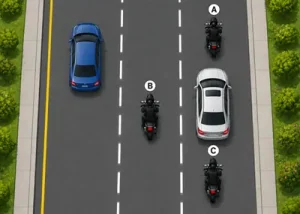
In the picture, the rider in the most dangerous position is:
(A)
Rider A.
(B)
Rider B.
(C)
Rider C.
Check Answer
Show Answer
When riders in a staggered formation pass a car, after the lead rider completes the pass, he or she should return to the:
(A)
Left portion of the lane.
(B)
Right portion of the lane.
(C)
Center portion of the lane.
Check Answer
Show Answer
When riding over a pothole, it is usually best to:
(A)
Keep a normal seated position.
(B)
Lean forward as much as possible.
(C)
Look straight ahead and rise slightly off the seat.
Check Answer
Show Answer
When riding at night, you should:
(A)
Wear reflective clothing.
(B)
Always ride in the center portion of the lane.
(C)
Follow the vehicle ahead more closely for safety.
Check Answer
Show Answer
While riding an unfamiliar motorcycle, you should:
(A)
Stay in the right portion of the lane.
(B)
Allow extra room for stopping.
(C)
Avoid shifting above third gear.
Check Answer
Show Answer
Question: 38
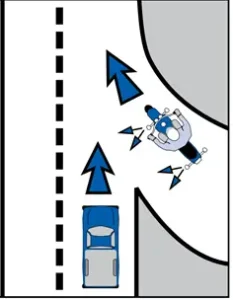
In the picture, the light most likely to make your motorcycle more noticeable to the car driver is the:
(A)
Brake light.
(B)
Taillight.
(C)
Turn signal.
Check Answer
Show Answer
When adjusting your mirrors to carry a passenger, the passenger should:
(A)
Sit on the motorcycle with you.
(B)
Stand behind the motorcycle.
(C)
Adjust the mirrors while you sit on the motorcycle.
Check Answer
Show Answer
If you lock the front tire while stopping, you should:
(A)
Release the rear brake.
(B)
Keep the front brake locked until you stop.
(C)
Release and then smoothly reapply the front brake.
Check Answer
Show Answer
Question: 41
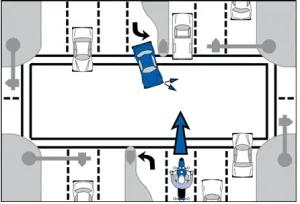
The driver turning left in the picture below is not stopping. Your best chance to avoid a collision would be to:
(A)
Maintain your position and brake hard.
(B)
Slow down and swerve to the left.
(C)
Reduce your speed and move away from the vehicle.
Check Answer
Show Answer
Before every ride, why should you check your motorcycle's tires?
(A)
To improve fuel economy only.
(B)
To make sure they have proper air pressure and enough tread.
(C)
To see if they match the motorcycle's color.
Check Answer
Show Answer
Which item should you check at least once a week, even if you ride every day?
(A)
Fluid levels.
(B)
Your registration card.
(C)
Your riding gloves.
Check Answer
Show Answer
When riding a motorcycle that is new to you, you should:
(A)
Ride normally because all motorcycles handle the same.
(B)
Accelerate quickly to learn its performance.
(C)
Ride cautiously and allow extra room for stopping.
Check Answer
Show Answer
Which control should snap back immediately when you release it?
(A)
The throttle.
(B)
The clutch.
(C)
The front brake lever.
Check Answer
Show Answer
Before starting your ride, you should adjust your mirrors so you can see:
(A)
Only your shoulders.
(B)
The lane behind you and as much of the lane beside you as possible.
(C)
The front wheel.
Check Answer
Show Answer
If your motorcycle has a chain drive, what should you inspect before riding?
(A)
Its tension, lubrication, and sprockets.
(B)
Its paint and decals.
(C)
Only its color.
Check Answer
Show Answer
When checking your brakes before a ride, you should:
(A)
Test only the front brake.
(B)
Make sure both brakes feel firm and hold the motorcycle.
(C)
Use the rear brake only.
Check Answer
Show Answer
When choosing a motorcycle that fits you, you should be able to:
(A)
Place both feet comfortably on the ground while seated.
(B)
Touch the ground with only one toe.
(C)
Reach the handlebars only by leaning forward.
Check Answer
Show Answer
If you notice a fluid leak under your motorcycle before riding, you should:
(A)
Ignore it if the leak is small.
(B)
Ride slowly until the leak stops.
(C)
Find the cause before riding.
Check Answer
Show Answer
Why is it important to inspect my motorcycle before every ride?
A quick pre-ride inspection can help you find problems such as low tire pressure, worn brakes, loose parts, or fluid leaks before they become safety hazards on the road.
How far ahead should I look while riding a motorcycle?
The California Motorcycle Handbook recommends scanning at least 10 to 15 seconds ahead so you have enough time to identify hazards and react safely.
What should I do before riding a motorcycle that is unfamiliar to me?
Take time to learn where all the controls are, perform a complete safety check, and ride cautiously until you become comfortable with how the motorcycle handles.